
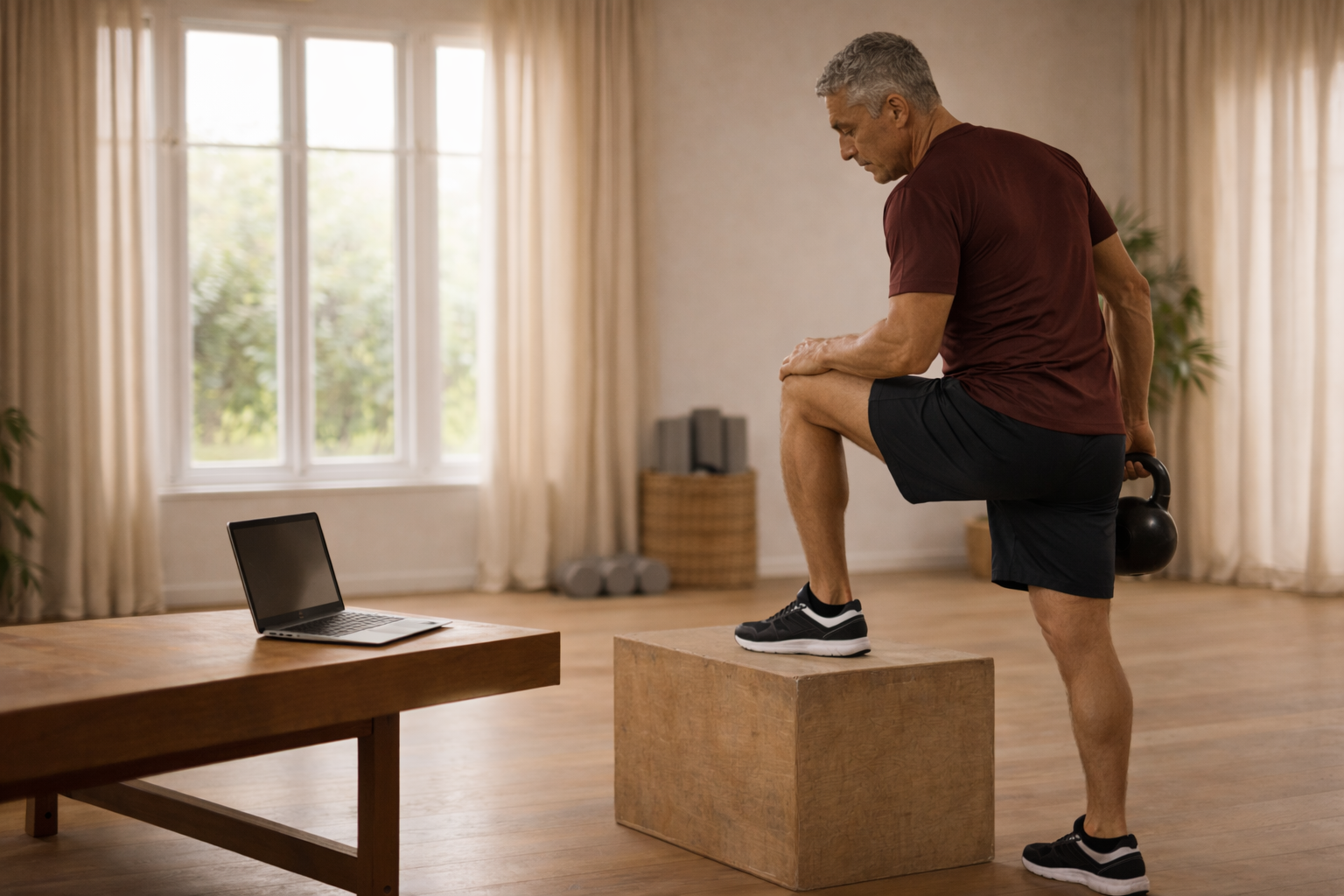
Online personal training is often presented as a replacement for in-person coaching.
That framing causes problems.
When online training is treated as a cheaper or more flexible version of face-to-face sessions, expectations are set incorrectly. People assume it should deliver the same experience, just at a distance. When it doesn’t, they conclude that online training itself doesn’t work.
In reality, online personal training works very well — when it is used for the right purpose.
Why online training fails when it tries to do everything
Most online training fails because it tries to replicate what happens in the room.
Live feedback. Real-time correction. Immediate motivation. Those things are difficult to reproduce remotely, and trying to do so often leads to over-complication or constant supervision that doesn’t scale.
For experienced trainees, this usually results in:
- generic programmes
- inconsistent check-ins
- reactive adjustments
- little continuity
The issue is not distance. It is misuse.
Online training works best when it is used to support consistency, judgement, and long-term decision-making, not moment-to-moment correction.
Online training works well for people who value consistency over intensity
In midlife, the biggest challenge is rarely effort.
Most people are still capable of training hard. What becomes harder is doing so consistently without interruption. Work, family, travel, sleep disruption, and recovery demands all compete with training.
Online personal training works well here because it supports:
- regular exposure rather than sporadic peaks
- decision-making between sessions
- continuity across busy or disrupted weeks
Progress is built through what can be repeated, not what can be forced occasionally.
It works well when the goal is longevity, not short-term performance
Short-term performance goals often require high levels of supervision, tight feedback loops, and short planning horizons.
Longevity goals are different.
They prioritise:
- staying injury-free
- maintaining capacity
- preserving strength and confidence
- avoiding repeated stop–start cycles
Online training supports this by shifting the focus away from individual sessions and toward how training unfolds over months and years.
When training decisions are made with a longer view, distance becomes less relevant.
Online training works well for experienced trainees
Online personal training is not ideal for beginners who need constant instruction or reassurance.
It works best for people who:
- already understand basic movement
- have training history
- know how effort feels
- can self-regulate day to day
For this group, the value is not demonstration. It is judgement.
Online coaching allows training decisions to be guided by context rather than observation alone. Adjustments are made based on patterns, not isolated moments.
It works well when risk management matters
As people age, the cost of mistakes increases.
Small issues linger. Recovery becomes less predictable. Pushing through problems creates longer interruptions.
Online personal training works well here because it:
- encourages reflection rather than reaction
- supports early adjustment before problems escalate
- reduces the pressure to “make the session count”
Training becomes something that fits into life rather than competes with it.
Online training supports habit stability
One of the most overlooked benefits of online personal training is habit stability.
Because sessions are not tied to a fixed location or appointment, training is less likely to collapse when schedules change. Travel, work pressure, or missed sessions do not derail the entire process.
This matters in midlife, where disruption is normal.
Habits that survive disruption are the ones that last.
What online personal training is not well suited for
Online training is not ideal when:
- constant real-time feedback is required
- motivation depends on being supervised
- training is treated as entertainment
- short-term performance outcomes are the only goal
Being clear about these limits improves outcomes rather than reducing appeal.
Why structure matters more than proximity
The success of online personal training has little to do with where the coach is.
It depends on:
- how training is structured
- how progression is managed
- how recovery is accounted for
- how decisions are made between sessions
When structure is strong, distance matters far less than people expect.
When structure is weak, proximity does not fix the problem.
What online personal training actually offers
At its best, online personal training provides:
- continuity
- perspective
- informed adjustment
- long-term oversight
It supports training that can be repeated without constant interruption. That is what most people in midlife actually need.
A more realistic way to judge whether it works
The right question is not:
“Can online training replace in-person coaching?”
It is:
“Does this help me train consistently, recover predictably, and continue long term?”
For the right person, online personal training answers that question very well.
This approach underpins my work through FormCoach, where online personal training is used to support consistency, risk management, and long-term capacity rather than short-term intensity or constant supervision.